



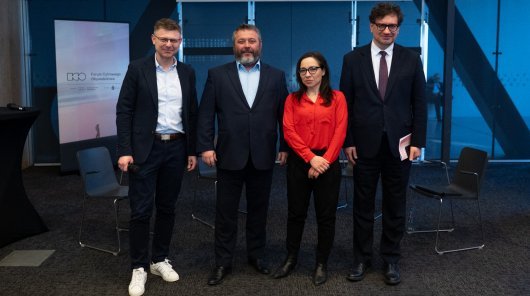
President of the Personal Data Protection Office Took Part in the Digital Citizenship Forum
On 18 March, during the second day of debates at the Digital Citizenship Forum, the President of the Personal Data Protection Office, Mirosław Wróblewski, participated in the panel “The Greatest Regulatory Challenges”, which focused on the possibilities of protecting personal data and privacy on digital platforms. The panel formed part of the Forum’s session dedicated to society and the economy.
The panel was preceded by an address from MP Monika Rosa, Chair of the Parliamentary Committee on Children and Youth, who highlighted the dangers faced by minors using the internet.
“For children and young people, the digital environment is now the environment of real life,” she emphasised, noting that the term “cyberviolence” somewhat weakens the meaning of the word “violence”, while in practice we are dealing online with ordinary violence, often of a sexual nature. She also pointed out that hate speech and patostreaming have become significant problems on the internet.
Her remarks were complemented by Krzysztof Mikulski, President of Polish Internet Research (PBI), who reminded the audience that the annual budget of the Polish state is now comparable to Meta’s annual budget and significantly smaller than Google’s. He also explained that PBI data shows that the presence of Polish children on Facebook alone allows Meta to generate over 55 million PLN annually.
The panel “The Greatest Regulatory Challenges”, moderated by Katarzyna Szymielewicz, President of the Panoptykon Foundation, and Dr Konrad Ciesiołkiewicz from the State Commission for Counteracting the Sexual Exploitation of Minors under 15, featured, alongside PDPO President Mirosław Wróblewski, Przemysław Kuna – President of the Office of Electronic Communications (UKE). He also addressed the issue of the lack of protective mechanisms available under the DSA.
“At present, we do not have the tools to protect children on social media platforms. We are one of five EU Member States that have still not implemented the DSA. And if there is no legislation, there can be no proper response from supervisory authorities,” President Kuna stressed.
President Wróblewski noted: “The DSA should be the main tool here, because the GDPR can only be applied to digital platforms in certain cases. Let us remember that the GDPR was created and is applied to protect personal data, but through this also other fundamental rights.”
He also emphasised that, in his view, nothing prevented the discussion on online abuse of children from being separated from the ongoing dispute over the method of implementing the DSA. Immediate solutions could have been introduced in situations where clear violations of the law against minors in the digital environment were identified, for example in cases of sexual offences. The overriding goal – the best interests of the child – requires swift and effective action. The President of the Personal Data Protection Office also pointed out that the European headquarters of major online platforms are usually located outside Poland. As a result, in matters concerning personal data protection, the consistency mechanism applies with regard to proceedings conducted by supervisory authorities in other EU Member States.
However, he noted that a significant point of reference for proceedings concerning abuses by digital platforms – and one that facilitates the work of supervisory authorities – is the CJEU judgment in Russmedia from December 2025. The Court held that, in relation to sensitive personal data, platforms have a proactive obligation to monitor the content they publish for compliance with data protection rules. (On the significance of this judgment, the President of the PDPO also addressed a letter to the Chancellery of the Prime Minister – https://uodo.gov.pl/pl/138/4055).
Mirosław Wróblewski further stressed that, regarding age‑verification methods for accessing platforms, we should make use of solutions enabled by the European Digital Identity Wallet.
During the discussion, participants also raised the issue of the number of authorities dealing with the digital sphere and the scope of their competences. According to President Przemysław Kuna, there is a need to clearly define these competences. President Wróblewski agreed that the multiplicity of authorities is not, in itself, a problem, as this is a matter of organisational autonomy of each state – something the EU allows. He added that cooperation between regulatory bodies in Poland functions well. The key criterion should always be the effectiveness and efficiency of protecting data and fundamental rights. He also noted that, at EU level, the European Data Protection Board (EDPB) fulfils the role of coordinating cooperation between data protection authorities.
The Digital Citizenship Forum is an interdisciplinary space for dialogue and knowledge exchange on the impact of the digital environment on society. The event was aimed at professionals working in this field, with the goal of supporting cross‑sector cooperation and building relationships among experts from academia, education, business, culture and health.
On the first day of the Forum, discussions focused on digital autonomy, the ethical dimension of new technologies, the impact of digital technologies on young people and their mental health. Workshops for teachers were also held.
The Digital Citizenship Forum, organised by the “Institute for Digital Citizenship” Foundation, took place at the Copernicus Science Centre in Warsaw on 17–18 March 2026.