



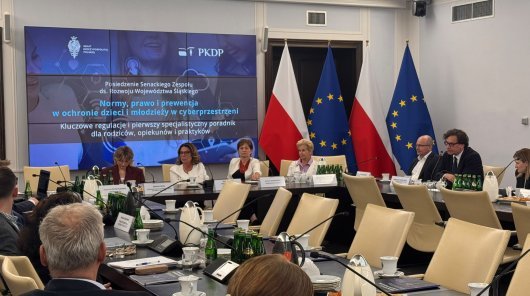
The protection of children’s data online was the subject of a debate in the Senate
On 29 July 2026, a debate entitled ‘Standards, law and prevention in the protection of children and young people in cyberspace’ was held in the Senate of the Republic of Poland, organised jointly with the State Commission for Combating the Sexual Exploitation of Minors Under the Age of 15.
The event was attended by Mirosław Wróblewski, President of the Personal Data Protection Office, who gave a speech entitled ‘The protection of minors’ data in cyberspace’.
During his speech, the President of the Personal Data Protection Office emphasised that the protection of children’s and young people’s personal data is not merely a technical or administrative issue. It forms part of the protection of minors’ dignity, privacy, safety, mental health and autonomy. He pointed out that whilst cyberspace has become a natural environment for learning, communication and building relationships, it is also a place where children may be exposed to profiling, manipulation, cyberbullying, phishing, identity theft or the irreversible loss of control over their own image.
“Children are a group requiring greater protection. This group is exposed to specific risks,” emphasised the President of the Personal Data Protection Office.
In his speech, Mirosław Wróblewski pointed out that the effective protection of children requires the simultaneous application of appropriate legal regulations, safe technologies, preventive measures and the establishment of appropriate social norms.
The Chairman also pointed out that every person, regardless of age, has a right to privacy. Parental authority does not entail the right to exercise unrestricted control over a child’s privacy, but should be exercised with due regard for the child’s dignity, rights and best interests. The views of a minor should be heard and taken into account in a manner appropriate to their age and maturity.
Mirosław Wróblewski emphasised that the GDPR recognises children as individuals requiring special protection, as they may be less aware of the risks, consequences and rights they are entitled to in relation to the processing of personal data. Information concerning, amongst other things, health, disability, family circumstances, psychological development or sexuality should be subject to special protection.
Referring to the scale of the challenges, the President of the Personal Data Protection Office cited figures showing that over 1.4 million children aged between 7 and 12 actively use the internet, and over 930,000 children aged between 7 and 14 have visited a pornographic website at least once. He pointed out that children often use digital services even before reaching the age required by the terms and conditions of online platforms. “This is not a marginal issue, but a social problem,” he added.
He also pointed out that young children often thoughtlessly provide their personal details in games, install apps, click on suspicious links, share photos or pass on information to strangers. A particularly dangerous phenomenon is child identity theft, the consequences of which may not become apparent until the child reaches the age of majority.
Mr Wróblewski also highlighted the risks associated with deepfakes and the publication of children’s images by schools and nurseries for promotional purposes.
“From the Office’s perspective, a child’s image is subject to special protection. Restraint in sharing it should be the rule. The commercialisation of a child’s image is not something we should approve of,” emphasised Mirosław Wróblewski.
He also mentioned cases reported to the Office involving unauthorised access to teachers’ accounts in electronic registers or the theft of passwords.
In conclusion, he highlighted the educational programme ‘Your Data – Your Concern’, which has been running since 2009 and aims to raise awareness amongst children, young people and teaching staff regarding the protection of personal data and the right to privacy.
“We are also seeing positive changes in the way children’s images are published. This shows that educational programmes are having a positive impact,” concluded the President of the Personal Data Protection Office.